I never thought that paying a few dollars for a stranger’s groceries would one day knock on my door and quietly rewrite my future.
My name is Lily. I’m 29 years old, raising three children on my own. Most days feel like a careful juggling act—one I’m barely managing. Our apartment is noisy, overcrowded, and always one unexpected expense away from falling apart.
That Thursday began like every other exhausting Thursday.
Emma was crying because Josh had eaten the “good” cereal. Josh swore he hadn’t. Max was racing through the living room in nothing but underwear, roaring like a dinosaur. My phone buzzed nonstop with reminders I didn’t want to face: overdue rent, a late electric bill, and a text from my boss asking if I could cover another shift.
I opened the fridge—no milk.
Checked the bread box—one dry end left.
Of course.
I told the kids I’d be back quickly and walked to the small grocery store down the street. The lights buzzed overhead. The air was uncomfortably cold. Every checkout line was long.
I grabbed the cheapest loaf of bread and a gallon of milk and joined the shortest line I could find.
That’s when I noticed the woman in front of me.
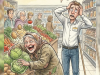
She was tiny and elderly, wrapped in a coat so worn it looked like it had lived many lives. Her back curved forward in a way that told a long story of hardship. She placed just two items on the belt.
Bread.
Milk.
The cashier scanned them and gave her the total. She opened a small, tired-looking wallet and began counting coins and crumpled bills with trembling fingers. After a few seconds, she stopped.
“I’m short,” she murmured. “I’m so sorry.”
The line shifted. Someone sighed loudly. Another person muttered about people wasting time. A woman behind her rolled her eyes.
“I’ll just take the milk,” the elderly woman said softly, hugging the bread to her chest for a moment before placing it back. “Please.”
That familiar tightness twisted in my stomach. I knew that feeling too well. I’d stood at a register like that before—heart racing, face burning, aware of every judgmental glance.
Before I could overthink it, I stepped forward.
“I’ve got it,” I said.
The cashier looked up. The line went briefly silent, then filled with whispers. Someone said I was foolish. Someone else scoffed that people like her knew how to get sympathy.
The woman turned toward me, her eyes both sharp and watery.
“No,” she said firmly. “You have children. Keep your money.”
“I’m not losing anything,” I replied. “I want to help.”
She studied my face for a long moment, then nodded. The cashier rang her items with mine.
She held the bread and milk like they were priceless.
“No one’s ever done something like this for me,” she whispered.
I asked her name.
Mrs. Hargrove.
She told me I had a kind heart—and warned me not to let the world harden it.
Then she left, walking past the same people who had just dismissed her, invisible once again.
I went home, made sandwiches, worked my shift at the diner, and made it through another long day. By the next morning, the moment at the store felt like just another fleeting memory in a life full of them.
Three days later, there was a knock at my door.
Not a casual knock—a firm one.
When I opened it, the grocery store clerk stood there holding a white envelope with my name written in shaky handwriting.
He told me Mrs. Hargrove had passed away.
She had collapsed at the store the day before.
He handed me the envelope and said she had asked him to find me—very specifically.
Inside was a letter.
She wrote that I had helped her when others mocked her. That I looked at her like she still mattered. She explained she didn’t want to leave anything to her children, who only cared about what she owned. She wanted to give what little she had to someone who showed kindness without questioning whether she deserved it.
Then I unfolded the documents.
She had left me her house.
And her savings.
Not enough to make us wealthy—but enough to change everything.
I sat frozen as my kids gathered around, asking questions I could barely answer. A real home. Security. Room to breathe.
Before leaving, the clerk told me one last thing.
Mrs. Hargrove didn’t see it as charity.
“She said it was a trade,” he told me. “You gave her kindness. She gave it back.”
That night, after the kids fell asleep, I sat at the table holding her letter and thought about that moment at the checkout counter—about how close I am, every day, to standing where she once stood.
Her final wish wasn’t about money.
It was about what I would do next.
I used to believe you had to have your life together before helping someone else. That day, mine was anything but.
I helped anyway.
And somehow, it came back to my door in an envelope with my name on it—asking me to become the person she believed I already was.
Now, I intend to try.